
Wildland Fire
About
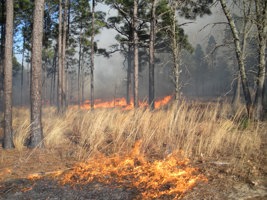
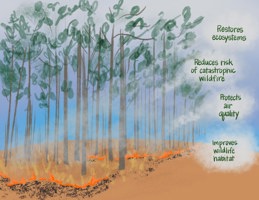
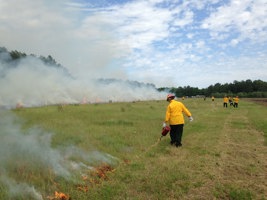
Fire is a natural and necessary process for maintaining healthy ecosystems, many of which serve as vital landscapes for military testing and training in the Southeast. Additionally, active military training and testing is a source of routine ignitions on installation training lands and test ranges. When applied in a controlled manner on and surrounding military installations, prescribed fire is a primary land management tool for maintaining accessibility, operational capability and installation resilience. It reduces the buildup of flammable vegetation, lowering the risk of catastrophic wildfires that threaten communities, critical military facilities and mission capabilities. Prescribed fire also sustains the habitats that depend on fire for survival, including many at-risk, threatened and endangered species. The SERPPAS Wildland Fire Work Group brings partners together to carry out a Comprehensive Prescribed Fire Strategy that increases coordination, collaboration, and implementation of prescribed fire across the region. This proactive, landscape-scale approach is critical to strengthening military readiness while safeguarding the Southeast’s biodiversity, resilience and defense mission landscape.
Strategic Objectives
- Identify, encourage, and support efforts to quantify and prioritize the use of prescribed fire to achieve desired conditions.
- Identify needs and opportunities to provide funding, capacity, and other support for prescribed burning in SERPPAS priority areas.
- Encourage new and share successful models of burn teams, Prescribed Burn Associations, and other collaborative burn groups.
- Increase burning across boundaries and sharing of personnel and equipment.
- Increase engagement with landowners, communities, and contractors by supporting programs that provide prescribed burning experience, training, and education.
- Encourage and support the development, dissemination, and utilization of new relevant fire science and tools that foster collaboration among scientists and natural resource managers and address the information needs of SERPPAS, regional fire managers, and partners.
- Promote cooperative conservation, protection of public health, and keeping areas in attainment with the National Ambient Air Quality Standards (NAAQS) by encouraging use of basic and enhanced smoke management practices.
- Support efforts that identify and seek to overcome gaps in knowledge, training, and information needs relevant to prescribed burn practitioners, policy makers, and partners.
- Leverage collaborative fire management partnerships and the research and development community to integrate research and emerging tools into fire operations that serve to enhance safety, effective fire planning, and protection of public health and mission critical values.
Work Group Lead

Jennifer Fawcett
Extension Associate, Forestry & Environmental ResourcesNorth Carolina State University
jennifer_fawcett@ncsu.edu
Jennifer Fawcett is an Extension Associate in the Department of Forestry and Environmental Resources, Extension Forestry at North Carolina State University (NCSU). She coordinates the SERPPAS Prescribed Fire Work Group and assists in implementing actions within the SERPPAS “Comprehensive Strategy for Prescribed Fire.” She received her M.S. degree in Forest Resources from Clemson University, and is working towards her Ph.D. in Agricultural Education and Human Sciences at NCSU, with a focus on Prescribed Burn Associations. Jenn currently serves as an Advisory Board member for the Southern Fire Exchange, is a past President for the North Carolina Prescribed Fire Council, and is on the leadership team for the National Extension Wildland Fire Initiative.
Paul Catlett
SE Regional Wildland Fire Coordinator, DoD Fire & Emergency Management ProgramsTexas A&M Natural Resources Institute
paul.catlett@ag.tamu.edu
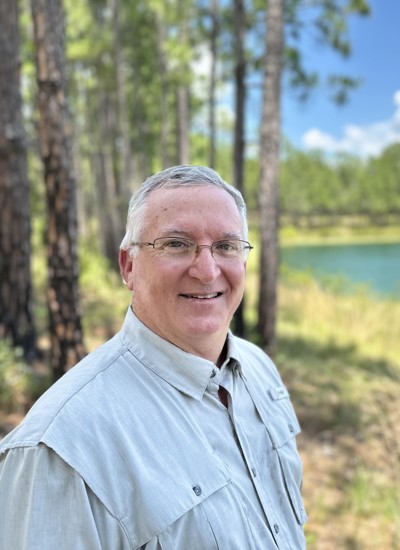
Paul Catlett graduated from the University of Florida with a bachelor’s degree in forestry. He worked as a forestry consultant for 7 years primarily conducting land management and prescribed fire in central and south Florida. In 1994, Paul became the Natural Resource Manager of Camp Blanding Joint Training Center, the primary training installation for the Florida National Guard in northeast Florida. Over the past 30 years, the red cockaded woodpecker was recovered on the installation and a wildland fire program was built that suppresses 100+ wildfires and conducts 20,000 acres of prescribed fire annually. In October 2023, Paul retired from the State of Florida and took a position with the Texas A&M Natural Resource Institute to support the Department of War's wildland fire transition to the National Wildfire Coordinating Group.
Resources
Documents


Websites
Southeast Prescribed Fire Update - Driptorch Digest
Southern Fire Exchange (SFE)
Consortium of Appalachian Fire Managers and Scientists (CAFMS)
Guidebook for Prescribed Burning in the Southern Region - Southern Regional Extension Forestry (SREF)
Prescribed Fire Training - University of Florida IFAS Extension
eFire - North Carolina State University - College of Natural Resources
SECAS Third Thursday Forum: Conducting prescribed fire under stronger air quality standards
Recording
PowerPoint Slides
SFE and SERPPAS Virtual Workshop on PM2.5 and Exceptional Events
*PowerPoint slides are accessible in the YouTube description.
SFE Webinar: The Intersection Between Bat Management and Fire in the Southeast
SFE Webinar Archive
News

See How The Southern Forest Network Connects
10/1/26
Keeping Forests has created a Network Explorer interactive map for partners from their 2023 Social Network Analysis (SNA) data. Keeping Forests asked 80 of its partner organizations to describe how they collaborate, critical issues driving their work, and the most available and needed resources to create impact.
Visit the SERPPAS News Archive
From Conflict to Collaboration: A Bulletproof Partnership
9/22/26
The Nature Conservancy released a YouTube video, From Conflict to Collaboration: A Bulletproof Partnership, which explores the relationship between the Red-cockaded Woodpecker (RCW) and Fort Bragg. As longleaf pine forests declined, the RCW found a new home within the longleaf pine ecosystem on the Fort Bragg landscape, where military training activities were taking place. At the time, the Army was not implementing the management practices necessary to support the species' recovery, and concerns about training impacts led to Fort Bragg receiving a federal jeopardy opinion from the U.S. Fish and Wildlife Service, which halted training activities to protect the RCW. The video highlights the importance of communication, trust, and understanding different perspectives when working toward shared goals.
Visit the SERPPAS News Archive
America's Longleaf Restoration Initiative 2025 RANGE-WIDE ACCOMPLISHMENTS
9/1/26
The America’s Longleaf Restoration Initiative released its 2025 Accomplishment Report! The report provides a comprehensive look at the progress, partnerships, and impact achieved over the past year in restoring and sustaining the longleaf pine ecosystem. In Fiscal Year 2025, partners established nearly 95,000 acres of new longleaf, implemented prescribed fire on 1.5 million acres, and protected over 80,000 acres of land. This year's report highlights strides in restoration, strong collaboration, and measurable conservation benefiting multiple groups.
Visit the SERPPAS News Archive
TREX Guidebook: Considerations for Planning a Prescribed Fire Training Exchange
8/1/26
A newly released Prescribed Fire Training Exchanges (TREX) Guidebook, Considerations for Planning a Prescribed Fire Training Exchange, has been released by the Fire Learning Network! This guidebook serves as a practical planning resource for fire practitioners looking to organize their own Prescribed Fire Training Exchange events. A TREX offers exciting opportunities for education and knowledge exchange on the fire line. Since starting in 2008, TREX has trained over 5,400
Visit the SERPPAS News Archive
Friends of Fire Podcast
8/1/26
The Southern Fire Exchange (SFE) has released a new series on its "Friends of Fire" podcast. The podcast discusses a variety of fire science topics relevant to the southeastern United States. This new series, Ft. Stewart ’25, follows SFE Outreach Specialist Christian Fernandez as he attends the Ft. Stewart Research Campaign, exploring collaboration and co-production for fire science and management through conversations with fire scientists, managers, and practitioners.
Visit the SERPPAS News Archive
An Introduction to the Guidebook for Prescribed Burning in the Southern Region
7/30/26
North Carolina State Extension Forestry recently released a new video introducing the Guidebook for Prescribed Burning in the Southern Region, authored by Southern Regional Extension Forestry, North Carolina State Extension Forestry, and many others. The video provides an overview of each chapter of the Guidebook, including Getting Started, Planning the Burn, Conducting the Burn, Evaluating the Burn, Weather, Smoke Management, Fuel, and Fire Behavior. Viewers can easily access specific chapter(s) with the chapter breakdown option.
Visit the SERPPAS News Archive
Events & Webinars
- Nature-Based Solutions (NBS) Short Course
-
October 13 - November 12, 2026
Virtual - 80th Annual SEAFWA Conference
-
October 26 - 30, 2026
Nashville, TN - 16th Biennial Longleaf Conference
-
October 27 - 30, 2026
Williamsburg, VA - Air Quality and Health Impacts of Prescribed Burning in the Southeastern US
-
November 17, 2026
Virtual - Beneficial Fire Summit
-
December 7 - 11, 2026
San Diego, CA - The Southern Group of State Foresters 2027 Annual Meeting
-
June 7 - 10, 2027
Stone Mountain, GA